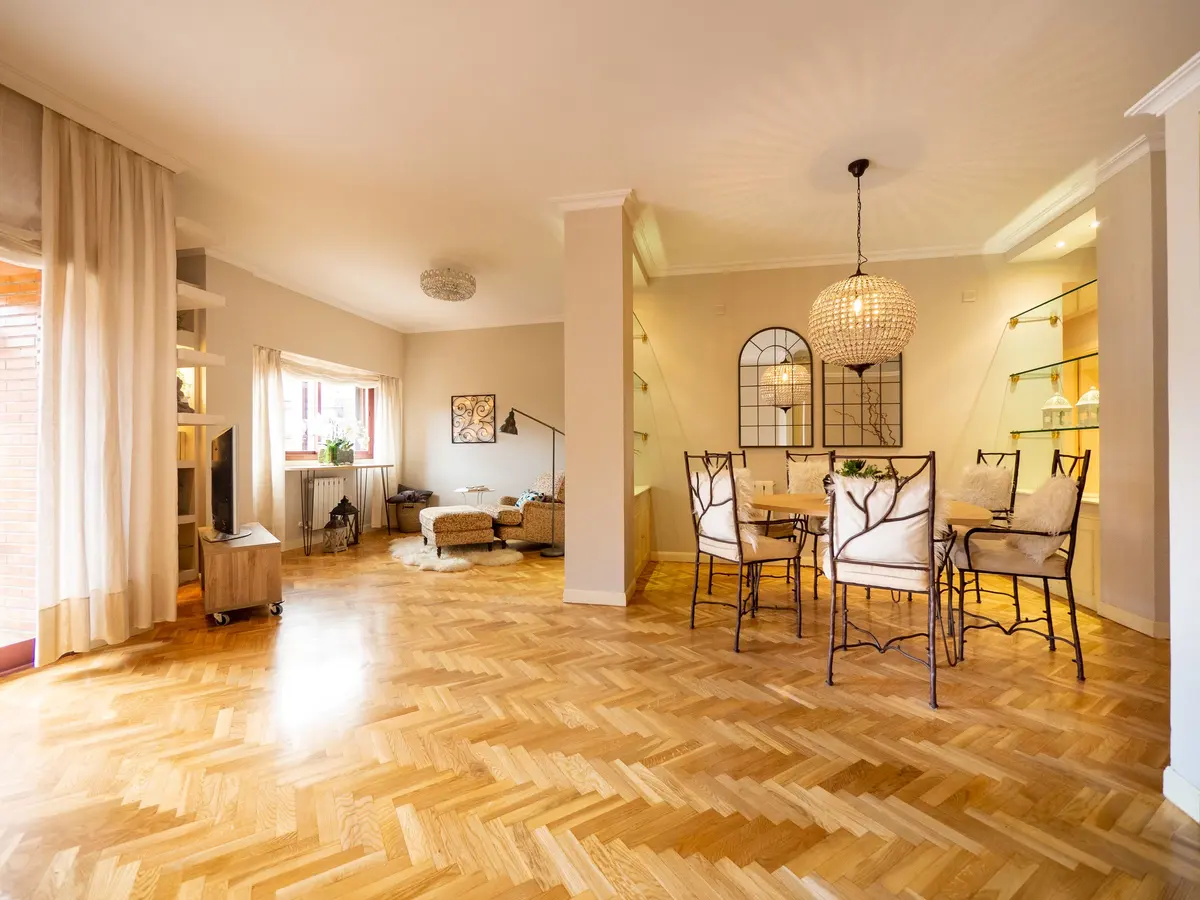
Solid and engineered hardwood are both real wood floors. Walk on a good example of each and you will not be able to tell which is which. The difference is entirely in how they are built, and it decides where each one can go.
What each one actually is
Solid hardwood is a single piece of timber, typically three-quarters of an inch thick, all the way through. Because it is one continuous piece of wood, it expands and contracts across its width with every change in humidity.
Engineered hardwood is a real hardwood wear layer bonded to a plywood core, with the plies running in alternating directions. That cross-grain construction is what stops it moving: the layers restrain each other, so the plank stays roughly the same width in February and in August.
Both are wood. Only one of them behaves like a board.
Why this matters in Central Ohio specifically
Our indoor humidity swings hard. A house in Newark or Granville runs somewhere near sixty per cent relative humidity in July and can drop under thirty in January once the furnace has been going for a month.
A solid hardwood floor moves with that. Installed properly — acclimated, with the right expansion gap at every wall, and with a humidifier keeping winter from getting too dry — it moves and comes back, and you may see fine seasonal gaps between boards in deep winter that close again in spring. That is normal and not a defect.
Installed badly, or in a house that goes from very humid to very dry with nothing moderating it, the same movement produces cupping, crowning or permanent gaps.
Engineered hardwood simply does much less of this. In a house with a big humidity swing and no humidifier, that is a meaningful advantage.
Where each one can go
**Above grade, over a wood subfloor:** either. This is solid hardwood's home ground and it is the case where the choice is genuinely open.
**Over a concrete slab:** engineered. Solid hardwood cannot be nailed to concrete and does not tolerate the vapour drive coming up out of it.
**Basements and below grade:** neither, honestly. If you want a wood look down there, luxury vinyl plank is the answer.
**Over radiant heat:** engineered, and only a product the manufacturer approves for it.
**Wide planks:** engineered. Movement scales with plank width, so a seven-inch solid board in a dry Ohio winter opens gaps that a seven-inch engineered board does not.
The refinishing question
This is the argument for solid hardwood, and it is a real one.
A three-quarter-inch solid floor has enough material above the tongue to be sanded and refinished several times. That is a floor that can outlive its owner and be brought back to new twice along the way.
Engineered can be refinished too, but only as many times as its wear layer allows. A two-millimetre wear layer is good for one careful sanding. A four to six millimetre wear layer is good for two or three, and at that thickness engineered stops being the compromise option in any practical sense.
Wear layer thickness is the number to ask for. An engineered floor with a very thin veneer is a different product from one with a six-millimetre top, even though both will be sold to you as engineered hardwood.
Refinishing itself is specialist work and not something we take on — we install new floors rather than resurface existing ones. It is worth knowing which of those two conversations you are having before you start shopping.
Cost
At 500 square feet installed, hardwood runs $3,750 at the entry level to $15,000 at the top, and the same spread applies to both constructions. Engineered is not automatically cheaper; a thick-wear-layer European oak engineered plank costs more than a basic domestic solid oak strip.
What you are buying at the top of that range is width, species, and the quality of the finish, not whether the core is one piece or five.
Species matters more than people expect
Hardness is measured on the Janka scale, and the practical version of it is this: white oak and hickory take life in a family house well, red oak is close behind, and softer species like American cherry and pine will show every dropped toy.
Finish matters just as much. A matte or wire-brushed surface hides scratches; a high-gloss surface displays them. If there are dogs or children in the house, texture is your friend.
How to decide
If you have a wood subfloor above grade, want a floor that can be refinished for decades, and either run a humidifier or accept a little seasonal movement, solid hardwood is the classic answer and there is a reason it has not gone away.
If you are going over concrete, want planks wider than five inches, have radiant heat, or would rather the floor did not react to Ohio weather at all, engineered is the better engineered product — and with a thick wear layer you give up very little.
We bring both to the house, put them on the floor of the room they are going in, and go through which one your subfloor and your humidity actually allow before anyone falls in love with a colour.