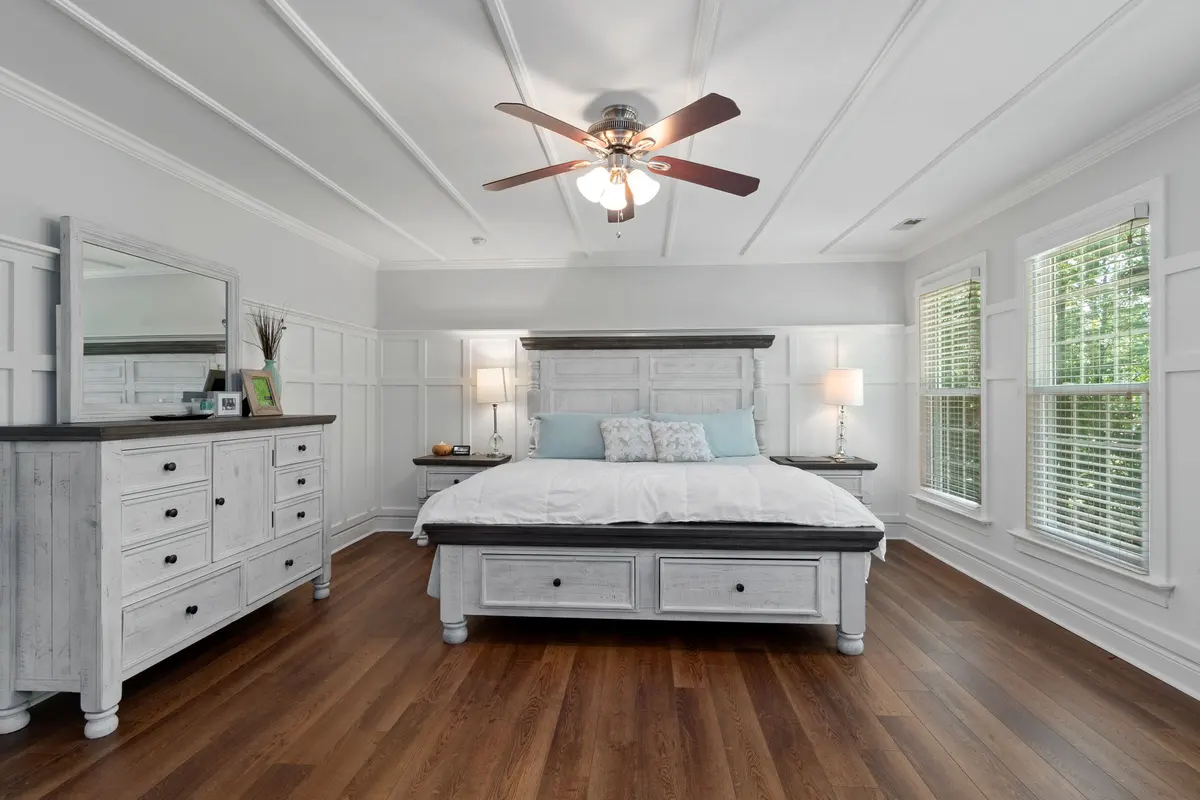
The east side of Columbus has been building houses as fast as it can for twenty years, and the first waves of that housing are reaching the age where the floors give out. Pataskala grew almost twenty percent in the last census decade. Pickerington added another twelve percent since. Johnstown and New Albany have subdivisions that went up in anticipation of the Intel site and are already lived in. Most of the flooring work we do in those towns is the same job: replacing what the builder put down.
Here is what builder-grade flooring actually is, why it fails on the schedule it does, and what to replace it with so you are not doing this again in another eight years.
What the builder put in, and why
A production builder chooses flooring the way they choose everything: to hit a price per square foot across hundreds of houses. That means the least expensive carpet that meets the spec, on a thin pad, usually a polyester or a low-density nylon in a neutral beige; the least expensive sheet vinyl or thin luxury vinyl plank in the kitchen, baths and laundry; and, if the house was at the upper end, a thin engineered hardwood or a laminate on the main floor.
None of that is a defect. It is a floor built to look good at the walkthrough and last through the warranty. The buyer upgrade packages were priced to make you feel the standard package was fine, and for the first few years it was.
Why it fails at year six to eight
Builder carpet fails at the pad and the fiber together. The thin pad bottoms out in the traffic lanes, so the carpet above it takes the crushing, and a low-density fiber does not spring back. By year six the hallway and the stair treads are matted flat and the bedrooms still look fine, which is exactly the pattern we see in Pickerington and Pataskala houses built in the mid-2010s.
Builder vinyl fails at the wear layer. A plank with a six or eight mil wear layer in a kitchen shows dull lanes in front of the sink and the fridge, and then scratches through to the print. Sheet vinyl, where it was used, lifts at the seams and the edges.
Builder laminate fails at the first real spill, at the dishwasher or the back door. Builder engineered hardwood, where it was installed, usually has a wear layer too thin to refinish, so once the finish scratches through there is nowhere to go.
The underlying cause in all four is that the product was chosen for cost, and cost is paid for in lifespan.
What you are replacing it with, room by room
The good news is that a house built in the last fifteen years has a flat, dry, sound subfloor almost every time, which makes the replacement fast and predictable. The main floor is typically plywood or oriented strand board over a basement or crawlspace, and the upstairs is the same. There is no old adhesive to grind, no three layers to remove, no surprises. Floor removal is straightforward and it is in our price.
Main floor, kitchen and family room. This is where most of the money and most of the change goes. A rigid-core, waterproof luxury vinyl plank with a 20 mil wear layer, run continuously from the front door through the kitchen and family room with no transitions, is the standard answer and the one that transforms how the house reads. It survives the kitchen, the mudroom and the dog, and it is what the next buyer will expect to find. Hardwood versus luxury vinyl plank is the honest comparison if you are tempted by real wood, and in a house at the New Albany end of the market, engineered hardwood on the main floor is the upgrade that pays.
Upstairs bedrooms and hallway. Carpet, but a real carpet: a dense nylon or triexta on a proper pad. The pad is the part the builder skimped on most, and it is the part that decides how the carpet feels and how long it lasts. Carpet versus luxury vinyl plank covers why we still put carpet upstairs.
Stairs. The builder's stairs are construction-grade plywood under carpet, and they always will be. Recarpeting them with a dense carpet, waterfall or Hollywood installed, is the sensible answer; a vinyl stair with matching nosings works if the stair is open to a vinyl main floor. What works on stairs goes through the options.
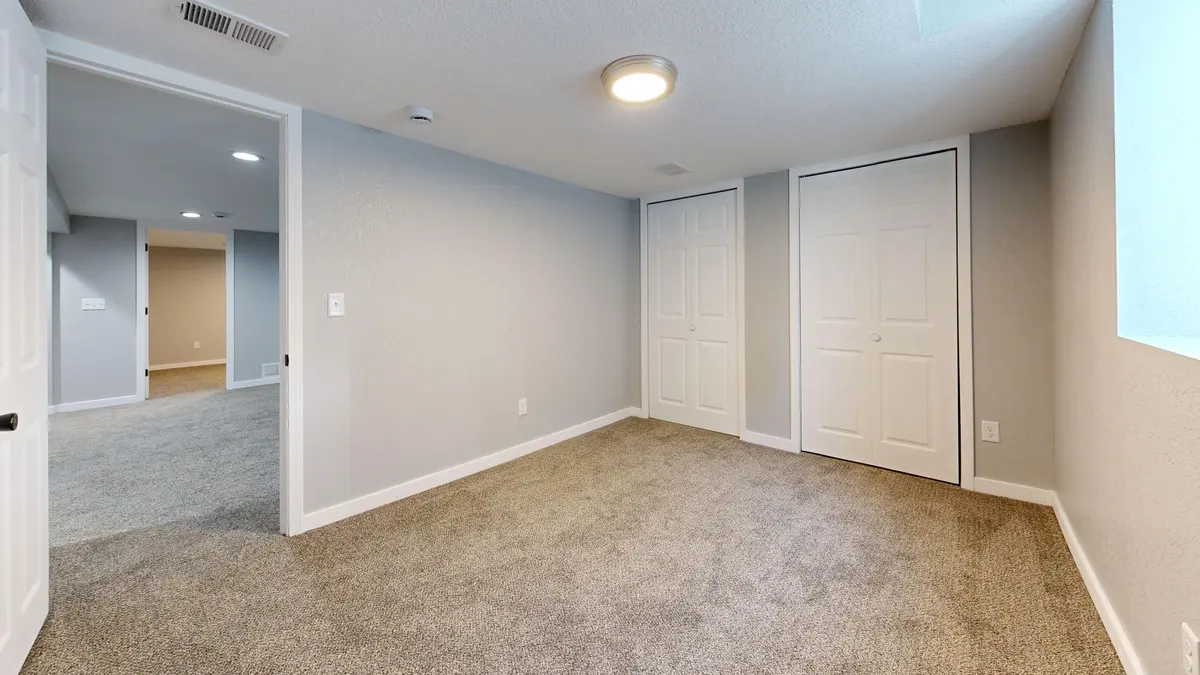
Basement. If the builder finished it, it has carpet on a slab or a thin vinyl, and either way the answer is waterproof luxury vinyl plank. Basement flooring in Ohio covers the moisture question, which is the only one that matters down there.
Do the whole level, not one room
The most common mistake is replacing the family room floor and leaving the kitchen, or doing the kitchen and leaving the hall. The result is a transition strip at every doorway and a house that reads as patched. In a newer open-plan home the main floor is one space, and it wants one floor. Doing it at once also costs less per square foot, because the setup, the removal and the furniture moving happen once. What a 500 or 1,000 square foot job costs is in our cost guide, and the tables on our pricing page are the installed prices we quote from.
The two upgrades worth paying for
Wear layer on the vinyl, and pad under the carpet. Those two lines are exactly where the builder saved money, and they are exactly where the difference between an eight-year floor and a twenty-year floor lives. The plank print and the carpet color are what you see in the showroom; the wear layer and the pad are what you live with. When we bring samples to the house we will show you the same look at two quality levels, and the difference in the price is almost always smaller than the difference in the lifespan.
Timing
A whole main floor in a newer house is typically a two- to three-day job; a full house with carpet upstairs and vinyl down is closer to a week. The subfloor being clean and flat is what makes it fast. How long flooring installation takes has the detail. If you are selling, the main floor alone is the highest-return version of this project, and it photographs.
We work across Pataskala, Pickerington, Johnstown, New Albany, Etna, Reynoldsburg, Canal Winchester and the rest of Licking and Franklin County, and the builder-grade replacement is the job we do more than any other. Book a free in-home estimate and we will bring the samples to the house, measure the whole level, and give you one written price with the removal, the pad and the installation in it.