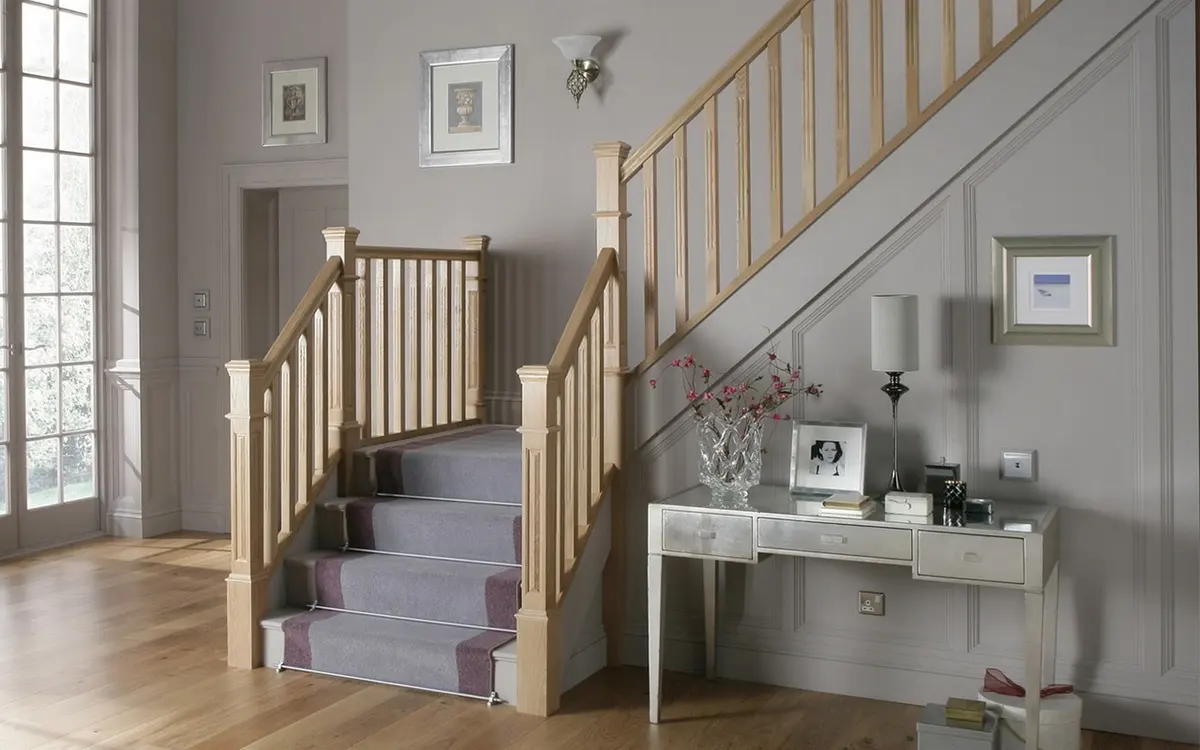
Stairs get walked on more than any equivalent patch of floor in the house, they sit at eye level from the front door, and they are the one place where a slip has consequences. They are also the part of a flooring project that people forget to plan for until the installer asks what they want done with them.
Here is how carpet, hardwood and luxury vinyl plank actually behave on a staircase, what is usually hiding under carpeted steps in a Central Ohio house, and why stairs are priced the way they are.
Safety first, because it is the real difference
A staircase is the one place where the surface decides how likely someone is to fall. Carpet is the safest: it grips socks, cushions a stumble and quiets every step. Hardwood and vinyl plank are harder and slicker, and a polished finish on a stair tread with someone in socks is a genuine hazard. If there are young children, older relatives or a big dog in the house, that alone can settle the choice, or point you toward a hard-surface stair with a runner.
Carpet on stairs
Carpet is the default on stairs in most Licking County houses and there are good reasons for it. It is safe, quiet, forgiving of a slightly uneven step, and it is the least expensive way to finish a staircase. It also hides the construction underneath, which matters, and we will get to why.
The things to get right are the fiber and the installation. Stairs wear at the nose of each tread faster than anywhere else in the house, so a dense, resilient carpet holds up far better than a soft plush; we steer stair carpet toward a nylon or a tight loop rather than the softest sample on the board. Installation should be a proper waterfall or a Hollywood wrap, with the carpet stretched tight over each tread and stapled under the nose so it cannot creep. Loose carpet on stairs is the most common stair complaint we see, and it is an installation problem, not a product one.
The drawback is that carpet on stairs shows wear first and shows dirt in the corners. Plan on stairs looking tired a couple of years before the bedrooms do.
Hardwood on stairs
A hardwood staircase is the most beautiful option and the one that adds the most to a house, particularly an open stair in a foyer that the front door looks straight at. It is also the most expensive, because a hardwood stair is built, not laid. Each step is a solid tread with a nosing, a riser and often a return on the open side, all cut and fitted individually.
The question to ask is what is there now. Many houses, especially older ones in Newark, Granville and Upper Arlington, have solid oak treads under the carpet, installed when the house was built and carpeted over later. Those can be uncovered, and a finishing contractor can bring them back, which is far cheaper than new treads. Newer houses in Pataskala, Pickerington and New Albany almost always have construction-grade plywood or particleboard stairs under the carpet that were never meant to be seen. Those need new treads and risers, which is the full price.
We will lift a corner of the carpet at the estimate and tell you which one you have.
Luxury vinyl plank on stairs
Vinyl plank on stairs is possible and increasingly common, but it is not the same as vinyl plank on a floor. Planks are cut to fit each tread and riser and glued down rather than floated, and each step needs a matching stair nose, a molded piece that wraps the front edge of the tread. Not every vinyl line makes a stair nose in every color, and a mismatched or metal nose is what gives away a budget stair job.
Done well, with matching nosings and a plank that has a textured, lower-gloss surface, a vinyl stair is durable, easy to clean and a good match for a vinyl main floor. It costs more than carpet and less than hardwood. It is harder and slicker than carpet, so a runner is worth considering on a busy stair.
Mixing: the hardwood stair with a carpet runner
The best of both is the most common upgrade we see in higher-end houses: hardwood treads and risers with a carpet runner up the center. The wood shows on both sides, the runner gives grip and quiet where feet actually land, and a worn runner is replaced without touching the stair. It costs the most up front, and it is the finish that a foyer in New Albany or Granville expects.
What is under your carpeted stairs
This decides the budget more than the material does. Lift the carpet on a staircase built after about 1990 and you will usually find plywood treads with a rounded plywood nose, or particleboard, painted at best. Those are structural, and they are fine under carpet or under glued vinyl with a proper nose. They are not fine exposed, and they cannot be finished to look like wood.
Lift the carpet on a staircase built before that, and there is a fair chance of solid oak or pine treads, often with a hundred nail holes and decades of paint on the risers, but solid and worth saving. That is a refinishing job rather than a flooring one, and we will tell you so.
How stairs are priced
Stairs are priced per step rather than by the square foot, because a step takes far longer than the equivalent area of floor. A carpeted stair with a matching landing might add a modest amount to a whole-house carpet job. A vinyl stair adds more, because each step is cut, glued and nosed by hand. A new hardwood stair is a construction job and is priced as one.
At Highmark, stairs, transitions and trim are measured at the in-home appointment and priced with the project, so the number you get is the number for the whole job. Stairs are the single most common reason a flooring quote from someone else moves after the fact, and it is worth asking any installer, before you sign, whether the stairs are in the price.
The transition at the top and the bottom
Where a stair meets the floor above and below is where the two materials have to agree. A carpeted stair meeting a vinyl hallway needs a proper transition at the top step so there is no exposed carpet edge to catch a toe. A vinyl stair meeting vinyl floors needs the top nose to sit flush with the hall floor. These are small pieces, and they are where a stair install looks either finished or not. They are part of what Stairs & Trim covers on every project.
Room-by-room recommendation
- Family house, kids and a dog, carpet upstairs: carpet on the stairs, dense nylon, waterfall or Hollywood installed
- Vinyl plank on the main floor, carpet upstairs: carpet stairs with a clean transition at the top, or vinyl stairs with matching nosings if the stair is open to the living room
- Open foyer stair in a higher-end house: hardwood, or hardwood with a runner
- Basement stairs: carpet for safety and quiet, or vinyl if the basement floods
- Rental or resale refresh on a budget: carpet
Carpet versus luxury vinyl plank covers the rest of the house, and what carpet costs installed has the carpet numbers. If the stairs need to stay easy for an older relative, flooring for aging in place covers contrast at the edges and keeping stair carpet secure. Whichever way the stairs go, we measure them at the estimate and the price you get includes them. Book a free in-home estimate and we will lift the carpet on the bottom step and tell you what you are working with.