A few weeks after the furnace comes on for the season, lines start to appear between the boards of a hardwood floor that was tight all summer. It happens to floors installed last August and to forty-year-old oak floors alike, and the question it raises is always the same: is something wrong with my floor?
Usually, no. Hardwood floor gaps in winter are the most common thing people worry about with a wood floor and, most of the time, the least serious. Here is what is happening, what is normal, and what is not.
Wood moves, and it moves across the board
Wood takes on moisture from humid air and gives it up to dry air, for as long as it exists. A finish slows that exchange down. It does not stop it.
As a board gains moisture it swells, and as it loses moisture it shrinks. Almost all of that movement is across the width of the board, not along its length. So a floor does not get shorter in winter. Each board gets a tiny bit narrower, and the difference shows up as a line between it and its neighbor.
Why it happens in winter here
Indoor humidity in Central Ohio swings hard. A house in Newark or Granville sits somewhere near sixty percent relative humidity in July and can drop under thirty in January once the furnace has been running for a month.
The cause is the heating. Cold outdoor air holds very little moisture, and when the furnace warms that air up without adding any water to it, its relative humidity falls further. By midwinter the air in a heated house can be drier than most people realize, and everything made of wood in it, including the floor, the trim and the furniture, slowly gives up moisture and shrinks.
In spring the process runs backwards. The windows open, the humidity climbs, the boards take moisture back on, and the gaps close.
What normal looks like
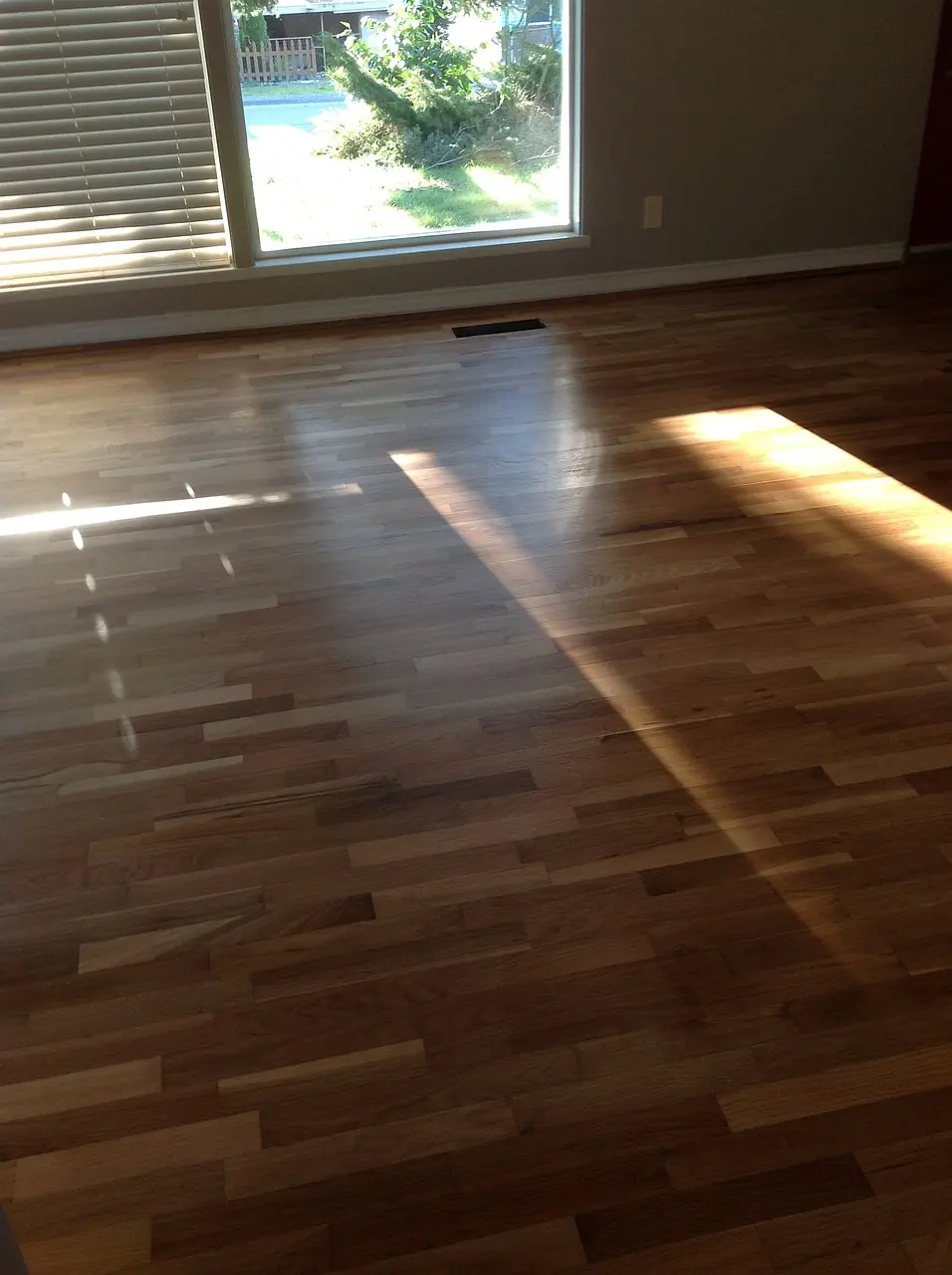
Normal seasonal gaps have a recognizable pattern:
- They appear a few weeks into the heating season and close again in spring
- They are fairly even across the room, not concentrated in one spot
- On a traditional narrow strip floor, they are thin, from a hairline up to about the thickness of a dime
- The boards stay flat, with no raised edges and no change in how the floor feels underfoot
If that describes your floor, it is behaving the way a solid wood floor behaves, and it is not a defect in the wood or the installation.
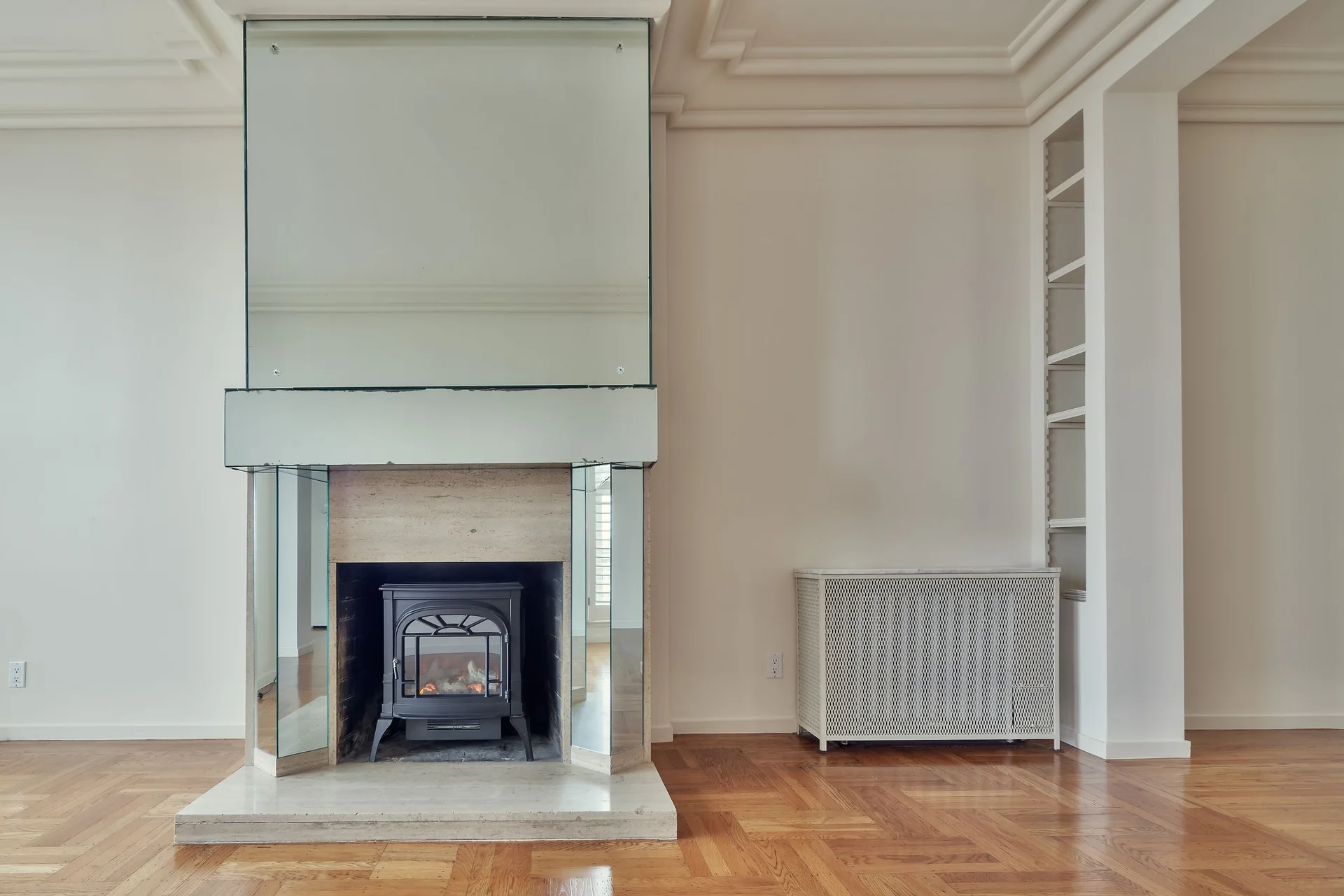
A few places always gap a little more than the rest of the room: beside floor registers, in front of a south-facing window or slider where winter sun warms the boards, and near a wood stove or fireplace. Those are the driest spots in the house.
Wide planks gap more
Movement is proportional to width. A given drop in moisture shrinks a seven-inch board by about three times as much as a two-and-a-quarter-inch strip, and because a wide-plank floor has fewer joints to share that movement between, each gap is visibly wider.
None of that means wide planks are a mistake. It means a wide solid plank floor in a house with no humidity control will show its seasons, and it is worth knowing that before choosing it. It is also the main reason we steer wide-plank projects toward engineered hardwood, whose cross-layered core moves far less. Engineered versus solid hardwood covers that trade in full.
Signs it is not seasonal
These are worth taking seriously:
- Gaps that do not close in summer. A gap still open in July is permanent. The usual cause is wood that was installed with more moisture in it than the house would ever hold again, so it shrank once and stayed there
- Gaps in one area only. A single wide gap, or a cluster of them, points to something local: a heat source, a board that has lost its fastening, or movement in the subfloor
- Cupping. Board edges sitting higher than the centers, so the floor looks faintly washboarded in low light. This is the opposite problem. The underside of the boards is wetter than the top, and the moisture is coming from below: a damp crawl space or basement, a plumbing leak, or a slab
- Crowning or buckling. Board centers higher than the edges, or boards lifting off the subfloor. These are moisture problems too, and the serious ones
- New squeaks or soft spots that arrive with the gaps. That can mean the movement is in the structure, not the flooring
Cupping, buckling and soft spots are not humidity-control problems, and a humidifier will make the first two worse. They need the moisture source found. The warning signs of subfloor trouble overlap heavily with this list.
What to hold the house at
The wood flooring industry's guidance, and the condition in most manufacturers' warranties, is to keep the home between about 30 and 50 percent relative humidity, at normal living temperatures, all year round.
Three things get you there:
- Measure it. A digital hygrometer costs less than a pizza. Put one in the room with the wood floor, not next to the humidifier, and look at it through a cold week. Most people are surprised by how low the number is
- Add moisture in winter. A whole-house humidifier on the furnace is the most effective fix because it treats all the air the floor sees. Portable room humidifiers work too, if they are sized for the room and actually kept filled
- Remove it in summer. Air conditioning does most of this on its own. A dehumidifier in the basement helps the floor above it, particularly in older houses with damp lower levels
The goal is not a perfect number. It is a narrower swing. A floor that lives between 35 and 50 percent moves a fraction as much as one that goes from 25 to 65.
One caution for a cold snap: in very cold weather, humidity in the forties can condense on windows. Turn the humidifier down a little during the coldest stretches. The floor will tolerate a few dry days far better than the window sills will tolerate weeks of water.
What not to do
Do not fill seasonal gaps. Wood filler, caulk or putty pushed into a January gap has nowhere to go in June. The boards swell, crush the filler or squeeze it out, and can be damaged at the edges in the process. Filler is for gaps that have been proven permanent through a full summer.
Do not add water to the floor. Wet mopping or steam cleaning a wood floor to put moisture back into it damages the finish and the board edges. The moisture has to come from the air.
Do not judge a floor in its first January. A new solid floor often shows its first gaps in its first heating season. Note where they are and how wide, and look again in June.
Why the installation decides most of this
How much a floor gaps is mostly settled before the first board is fastened. Wood that goes down while it is still carrying more moisture than the house does will shrink as it dries, and those gaps do not come back. That is why acclimation is a stage of the timeline and not a delay.
On our installations the subfloor and the wood are both tested with a moisture meter, and the difference between them has to be within the manufacturer's tolerance before anything is fastened. In practice that means the material sits in the room for several days with the heating or cooling running the way you normally run it. Expansion space is left at every wall and fixed object, and covered by the trim.
It is also a product decision. For a house with no humidifier and no plans for one, a wide solid plank is the wrong floor, and engineered hardwood is the right one. For a room where even seasonal movement would bother you, or where water is part of daily life, luxury vinyl plank gives the look of wood without the movement.
Humidity is one part of looking after a wood floor. How to clean and protect hardwood floors covers the rest of the routine.
If the floor is past saving
We install new floors, and we do not sand, refinish or repair existing ones. If an older floor has permanent gaps but is otherwise sound, a refinishing specialist can often fill and refinish it, and that is usually the better value.
If the floor is cupped, water-damaged or at the end of its life, replacement is the conversation, and it starts with finding out why it failed. For new hardwood flooring in Licking County or the Columbus area, book a free in-home estimate. We bring solid and engineered samples to the house, look at the subfloor, and tell you which one your home's humidity will actually support.