Most small businesses replace their floor about once a decade, and usually because it has become embarrassing: a carpet with a dark path from the front door to the break room, rippled under the desks, frayed where the chairs have been rolling for years. By then the question is not whether to replace it. It is what goes down instead, and how to do it without shutting the doors for a week.
This guide is for offices, professional suites, small retail spaces and tenant spaces around Licking and Franklin County. It covers the kind of commercial flooring job where the owner is also the person who has to keep the phones answered while the work happens.
Start with the calendar, not the samples
On a commercial job the flooring is a manageable expense and the downtime is not. A suite that cannot be used for three days usually costs more than the difference between two carpet specifications, which is why the order of the work matters more than almost anything else in the quote.
So before anyone talks about color, it is worth answering a few questions:
- Which areas can be closed, and for how long
- Whether work can run in the evening or across a weekend
- Whether the space can be done in phases, so part of it stays open
- What has to move: desks, filing cabinets, shelving, display fixtures, equipment
- Whether there is a fixed date, such as a lease start, an opening or an inspection
Those answers change the plan, and they often change the product. A floor that goes down quickly and in sections is worth more to a business that has to stay open than a slightly nicer one that needs the whole space empty.
Carpet tile: the usual answer for offices
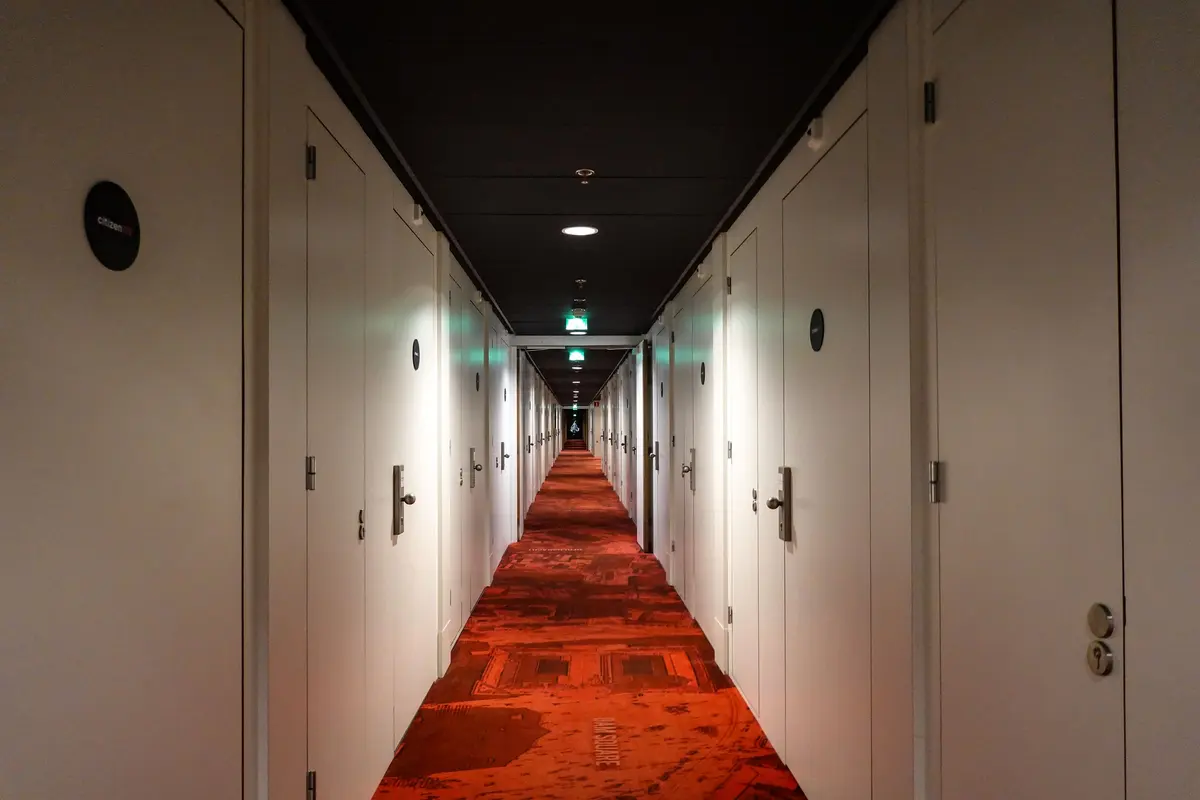
For a set of offices, a corridor and a reception area, commercial carpet tile is usually the sensible choice, for reasons that are mostly practical.
It installs in sections. Desks move to one side, a run of tile goes down, and the furniture moves back. An occupied office can be done in stages rather than emptied.
It repairs in pieces. A coffee stain that will not come out, a worn patch in front of the copier, a spot where something heavy was dropped: the damaged tiles lift out and new ones go in without touching the rest of the floor. Keep a few boxes of spare tiles from the original order for exactly this.
It handles chairs. Rolling office chairs are what destroy office floors. Casters on a soft residential carpet cut a visible track within a year. A dense, low commercial carpet tile is built to take that load.
The limitation is appearance. Carpet tile reads as commercial, which is right for an office and less right for a boutique or a client lounge. Patterned tiles and a considered installation layout go a long way toward hiding the grid.
Broadloom: where it still makes sense
Broadloom, which is carpet off the roll, gives a seamless, softer and quieter floor than carpet tile quite manages. It suits private offices, conference rooms, a counseling suite, or anywhere the room is meant to feel less like a workplace.
Its trade-offs are the reverse of tile's. The room needs to be cleared to install it, and a damaged area means a patch or a replaced section rather than one lifted tile. Anywhere that sees rolling chairs all day, it needs to be a commercial-grade product, and it usually wants chair mats under the desks.
Vinyl plank: for rooms that get wet or dirty
Commercial-grade luxury vinyl plank belongs in break rooms, restrooms and entries, and on customer-facing floors that take wet shoes, spilled drinks or a lot of grit: a salon, a small clinic, the area in front of a retail counter.
What makes it suitable for commercial traffic is mostly the wear layer. A thicker wear layer stands up to foot traffic that would dull a residential product in months. Where carts or heavy rolling loads cross the floor, a glue-down installation is often a better choice than a floating one, because a glued floor does not shift underneath them.
For a business that wants a wood look throughout, vinyl plank in the public and wet areas with carpet tile in the offices, joined by clean transitions, is a common combination and a good-looking one.
Laminate: dry, busy and budget-conscious
Laminate carries an abrasion class rating from AC1 to AC5, and AC4 and AC5 are rated for commercial use. In a dry, light commercial space such as an office that wants a wood look, a small showroom or a studio, a high-rated laminate is a very hard-wearing surface at a sensible price.
It is not the right product for a break room, a restroom or an entry that takes winter boots, for the same reason it is wrong in a residential mudroom. Laminate has a fiberboard core, and fiberboard does not recover from water that sits on it.
Specify by room, not by building
Commercial traffic is a different order of magnitude from residential. A reception area can see more foot traffic in a week than a family room sees in a year, and a product rated for a home will look worn out there within months.
But the private office at the end of the corridor is not the lobby, and specifying it as though it were is money spent on nothing. A typical breakdown looks like this:
- Entry and reception: the hardest-wearing product in the space, plus proper entry matting
- Main corridors and open work areas: commercial carpet tile or commercial vinyl plank
- Private offices and conference rooms: a lighter commercial product, or broadloom where quiet matters
- Break rooms and restrooms: vinyl plank, usually glued down
Entry matting is worth more than it costs
Most of what wears out a commercial floor is grit carried in on shoes, and most of that grit comes off in the first few steps inside the door. A walk-off mat long enough to take several steps on extends the life of every square foot beyond it.
In a Central Ohio winter, with salt and slush on every pair of shoes, it is the least expensive floor protection a business can buy.
Tenant spaces and what is under the old floor
Fit-outs and turnovers between tenants come with a fixed window and, often, a slab nobody has looked at since the building went up. Old carpet adhesive, a patch where a wall used to stand, a low spot where a sink was removed. Any of those can add a leveling day, and it is far better to find that out before a date is committed to than on the first morning.
What floor removal involves and the warning signs of subfloor trouble apply to a commercial suite as much as to a house.
For landlords, being able to replace part of a floor between tenants rather than all of it is often the deciding factor, and it is worth building into the original choice. Carpet tile and vinyl plank both allow for it.
How a commercial quote works
Commercial jobs are not priced off a rate card, because the variables that matter most are not square footage. We visit the site, measure, look at the existing floor and what is underneath it, check the access, and talk through the schedule. A ground-floor suite with a wide rear door and a second-floor office up a public staircase are very different days of work, even at the same size. The price comes after that visit.
The same preparation, cleanup and final walkthrough we do on residential jobs apply to commercial ones. If you run an office, suite or small commercial space in Licking or Franklin County, our commercial flooring page covers how we work, or call (740) 614-0911 to arrange a site visit.