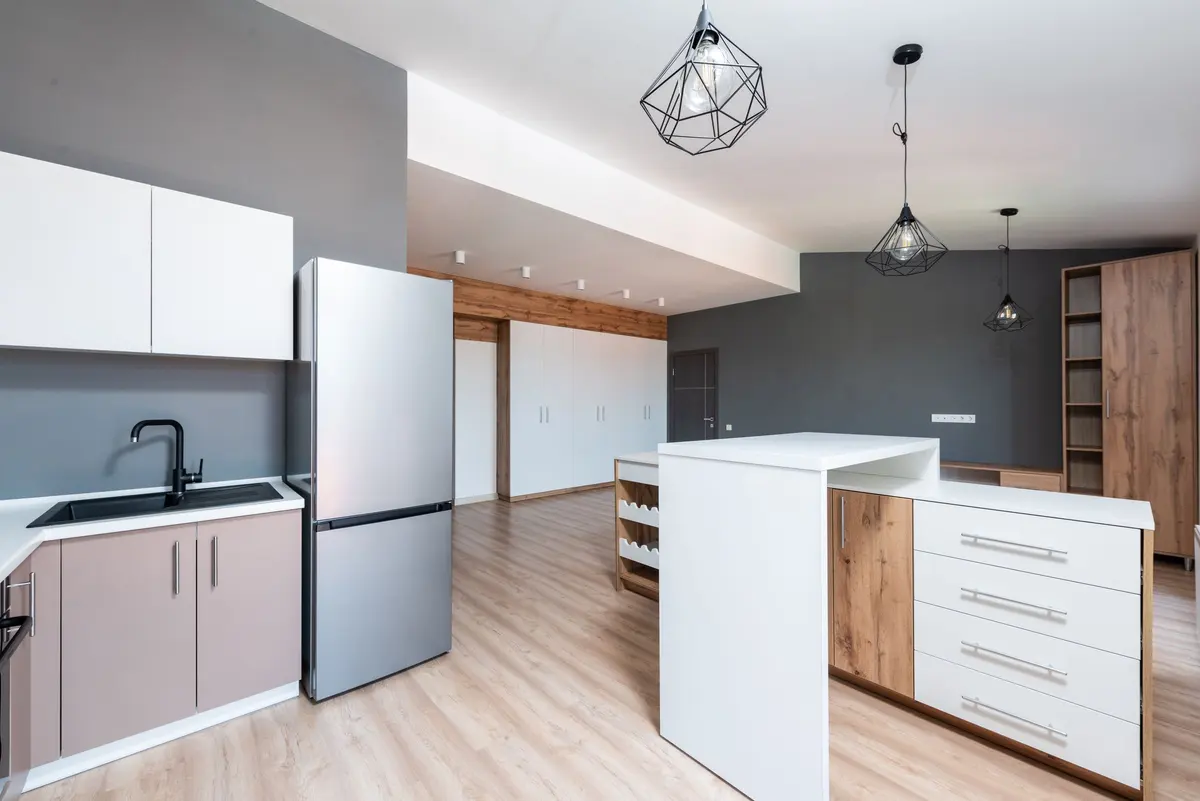
Every weakness a floor has, a kitchen will find. Water from the sink, the dishwasher and the fridge line. Dropped pans and dragged chairs. Grease, road salt tracked in from the garage in February, a dog's water bowl, and hours of standing at the counter. A floor that is fine in a bedroom can be a mistake in a kitchen, and the reverse is true too.
We replace kitchen floors across Licking and Franklin County every week, and the same three materials come up every time. This is how they compare in an actual Central Ohio kitchen, and what we end up recommending most.
What a kitchen floor has to survive
Water, in small amounts constantly and in large amounts occasionally. Every kitchen gets the first; most kitchens eventually get the second, from a dishwasher, an ice-maker line or a sink trap. The floor has to shrug off the first and survive the second.
Impact and abrasion: dropped cans, dragged chairs, grit and salt from the driveway. The floor has to resist dents and scratches or hide them.
Standing. People cook standing up, and a hard, cold floor is tiring and unforgiving of a dropped glass. Comfort is real, and it is why a lot of people who love the look of tile end up choosing something else. We do not install tile, and in most Central Ohio kitchens we would not recommend it anyway, for exactly that reason.
Luxury vinyl plank: what we recommend most
Waterproof through and through, warmer and softer underfoot than tile, quiet, and available in wood and stone looks convincing enough that most guests will not know. A rigid-core plank with a 20 mil wear layer resists dents and scratches well, and if a plank is damaged it can be swapped rather than replacing the floor.
The trade-offs are real but manageable. Thin planks dent under a heavy refrigerator foot, so buy the rigid-core product. Vinyl adds less at resale than real wood in a higher-priced house. And it has to go over a flat, sound subfloor or it will show every ridge, which is why subfloor preparation is part of every kitchen job we do.
For the majority of kitchens, including the open plans in newer Pataskala, Pickerington and New Albany houses where the kitchen runs straight into the family room and you want one floor throughout, this is the answer. The difference between waterproof and water-resistant plank matters more in a kitchen than anywhere else in the house, and it should be the waterproof kind.
Hardwood: beautiful, valuable, and a calculated risk
Real wood in a kitchen is a classic look and it does the most for resale, particularly when the same floor runs through the rest of the main level with no transition at the kitchen doorway. Engineered hardwood with a hard factory finish handles everyday spills fine as long as they are wiped up, and it is warmer and more forgiving underfoot than any hard tile.
The risk is the big leak. A dishwasher that fails overnight can cup and stain a hardwood kitchen floor badly enough that boards come out, and a finish worn through in front of the sink lets water into the wood. If you go this way, choose a prefinished engineered board, put a water alarm under the sink and behind the dishwasher, and accept that you are choosing looks and value over invincibility. Hardwood versus luxury vinyl plank goes through the whole trade in detail, and engineered versus solid explains why a kitchen floor should be engineered.
Laminate: only the water-resistant kind, and only in the right kitchen
Old laminate does not belong in a kitchen. Its fiberboard core swells the first time water sits at a joint, and swollen laminate cannot be repaired. Modern water-resistant laminate with sealed edges changes that for everyday spills, and it brings the best scratch resistance and the most solid, wood-like feel of any of the wood-look options.
What it still cannot handle is water that sits for days or comes from below. A kitchen with a history of leaks, or one over a damp crawlspace or basement, is not the place for it. In a dry kitchen with reliable plumbing and a busy household that will scratch anything, it is a genuine contender, and laminate versus luxury vinyl plank covers the rest of that decision.
The Ohio details that decide it
Road salt. From December to March, whatever is on the driveway ends up on the kitchen floor by way of the garage door, and salt is abrasive. A walk-off mat at the garage entry is the cheapest floor protection you can buy, and a floor with a hard wear layer is the second cheapest.
The dishwasher. If a new floor is laid up to a dishwasher already sitting under the countertop, the new floor height can trap it. We pull it before the floor goes down and check the clearance, because a dishwasher that cannot come out without lifting the counter is a miserable discovery a year later.
Height at the doorways. A kitchen floor that changes height at the family room and again at the hallway is two transitions and two trip edges. Running one floor through the whole main level is the cleanest answer, and it is one of the reasons luxury vinyl plank has become the default: it can go in the kitchen and keep going.
The subfloor. Older kitchens in Newark and Heath often have two or three generations of floor over the original subfloor, and a soft spot near the sink or the dishwasher is common. We take it all up, look at what is there, and fix it before anything new goes down. On most projects that removal and preparation is already in the price.
Resale, briefly
Buyers walk into the kitchen first. Real hardwood adds the most in New Albany, Granville, Dublin and Upper Arlington. In most houses, a well-installed wood-look luxury vinyl that runs seamlessly into the living area shows better than a worn laminate or a dated sheet vinyl and is a genuine plus in a listing.
What we would put in your kitchen
For most homes: rigid-core waterproof luxury vinyl plank, run continuously into the adjoining rooms. For a house with hardwood everywhere else and an owner who will look after it: prefinished engineered hardwood with water alarms. For a busy family on a dry subfloor with reliable plumbing: water-resistant laminate is a real option and a little cheaper. What each costs installed is in our cost guide, with the full tables on the pricing page.
We bring the samples to your kitchen so you can see them on your own floor, next to your own cabinets, in your own light. Book a free in-home estimate, and we will check the subfloor and the dishwasher clearance while we are there.